
Les Lazaristes, l’Évangélisation de l’Île Maurice et l’Esclavage
DOI :
https://doi.org/10.35312/8d434b98Mots-clés :
Esclavage, Île Maurice, Lazaristes, EvangelizationRésumé
Cette étude explore le rôle de la Congrégation de la Mission (les Lazaristes) dans l’évangélisation de l’île Maurice, au sein du contexte historique complexe de l’expansion coloniale et de l’esclavage. Située sur les principales routes maritimes reliant l’Europe, l’Afrique et l’Asie, l’île Maurice est devenue une société multiculturelle façonnée par des populations asservies venues d’Afrique et d’Inde, auxquelles se sont joints par la suite des travailleurs sous contrat sous la domination britannique. Les Lazaristes ont joué un rôle fondamental dans l’édification de l’Église catholique sur l’île, plusieurs d’entre eux occupant des fonctions de direction ecclésiastique. Cependant, leur mission s’est déroulée dans le climat de tension morale d’une société fondée sur l’esclavage. Tout en restant engagés dans le système colonial, ils ont cherché à proclamer l’Évangile à tous – colons et esclaves confondus – en adaptant leurs pratiques pastorales à des conditions difficiles. Cette étude met en lumière à la fois l’engagement évangélique et les ambiguïtés de l’action missionnaire, révélant comment les missionnaires vincentiens ont tenté de vivre et de proclamer l’Évangile au milieu de l’injustice structurelle et de la diversité culturelle.
Références
FILLIOT J.-M. 1974. La traite des esclaves vers les Mascareignes, au XVIIIe siècles, Editions de l’Office de la Recherche Scientifique et Technique Outre-Mer.
MEZZADRI, Luigi and ONIS Francesca. 2013. Les Lazaristes, un histoire générale de la Congrégation de la Mission, le XVIIIe siècle de 1789, New York City press.
THIEFFRY, Marc. 2017. Les Lazaristes aux mascareignes au XVIIIe et XIXe siècles Île Bourbon (Réunion) et Île de France (Maurice), Ed L’harmattan, Paris.
PROSPER, Eve. 2021. Les ébauches urbaines dans les Mascareignes au XVIIIe siècle, p. 59-90.
PROSPER, Eve. 2025. Eglise et seclavage à Bourbon (https://www.portail-esclavage-reunion.fr/documentaires/l-esclavage/leglise-et-lesclavage/leglise-et-l-esclavage/)
Groëme-Harmon, Aline. 2025. Il y a 300 ans: les débuts dans la «sueur et le sang» de l’Église à Maurice (https://lexpress.mu/s/article/412759/il-y-300-ans-debuts-dans-sueur-et-sang-leglise-maurice)
https://www.portail-esclavage-reunion.fr/a-la-une-eglise-etat-et-esclavage/
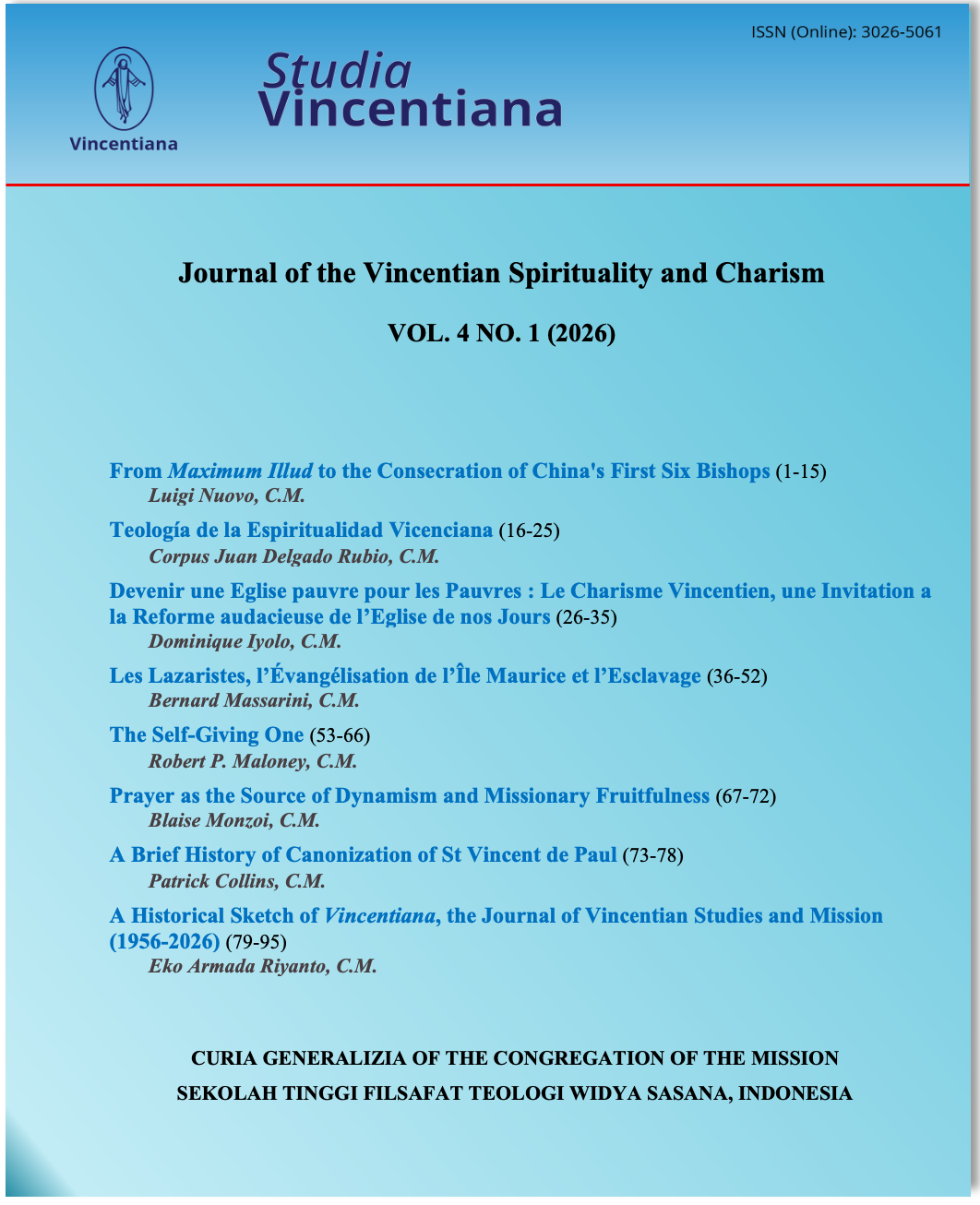
Téléchargements
Publiée
Numéro
Rubrique
Licence
(c) Copyright Bernard Massarini, C.M. (Author) 2026

Ce travail est disponible sous licence Creative Commons Attribution - Pas d’Utilisation Commerciale - Partage dans les Mêmes Conditions 4.0 International.
License and Copyright Agreement
In submitting the manuscript to the journal, the authors certify that:
- They are authorized by their co-authors to enter into these arrangements.
- The work described has not been formally published before, except in the form of an abstract or as part of a published lecture, review, thesis, or overlay journal.
- That it is not under consideration for publication elsewhere,
- That its publication has been approved by all the author(s) and by the responsible authorities "tacitly or explicitly" of the institutes where the work has been carried out.
- They secure the right to reproduce any material that has already been published or copyrighted elsewhere.
- They agree to the following license and copyright agreement.
Copyright
Authors who publish with Studia Vincentiana agree to the following terms:
- Authors retain copyright and grant the journal right of first publication with the work simultaneously licensed under a Creative Commons Attribution License (CC BY-SA 4.0)that allows others to share the work with an acknowledgment of the work's authorship and initial publication in this journal.
- Authors are able to enter into separate, additional contractual arrangements for the non-exclusive distribution of the journal's published version of the work (e.g., post it to an institutional repository or publish it in a book), with an acknowledgment of its initial publication in this journal.
- Authors are permitted and encouraged to post their work online (e.g., in institutional repositories or on their website) prior to and during the submission process, as it can lead to productive exchanges, as well as earlier and greater citation of published work.

