
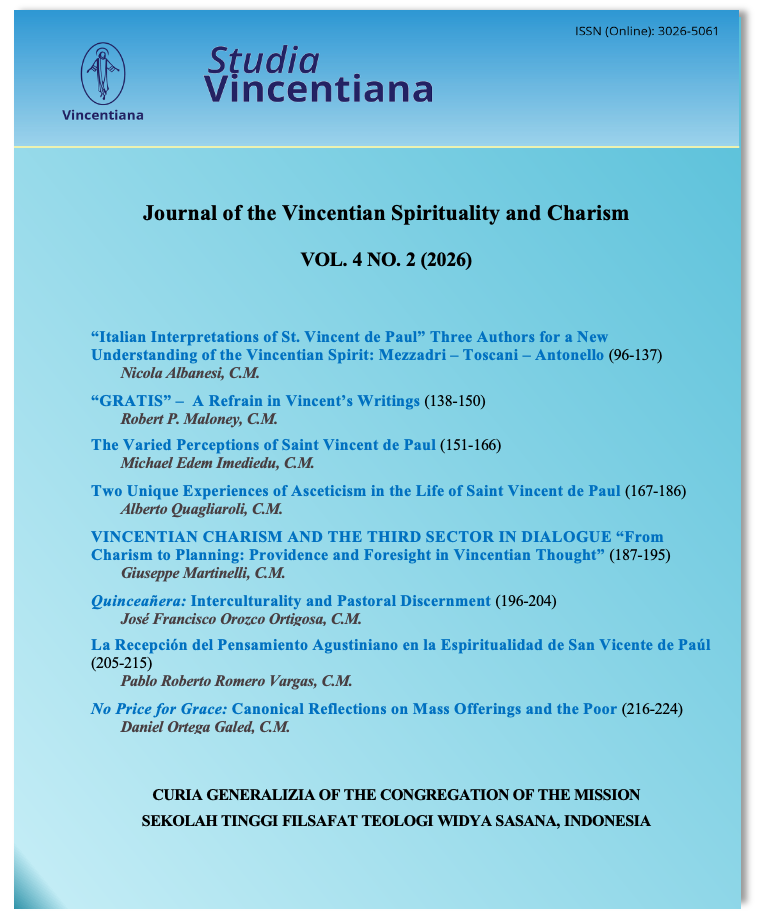
La gracia no tiene precio: Reflexiones canónicas sobre las ofrendas para la Misa y los pobres
DOI:
https://doi.org/10.35312/wz0mcs91Palabras clave:
Offering, Mass, The Poor, Spiritual goodsResumen
En el contexto cambiante de la práctica de los sacramentos en la Iglesia, resurge una pregunta profunda sobre las ofrendas de misa, especialmente a la luz del decreto publicado por el Dicasterio para el Clero en abril de 2025. Los cánones 848 y 945 §2 subrayan la justicia y la generosidad al aceptar intenciones de misa, especialmente cuando provienen de los pobres. ¿Cómo debemos responder pastoralmente a quienes, por su pobreza, no pueden hacer una ofrenda? Esta pregunta es especialmente significativa para nosotros, los vicencianos, que desde el contrato de fundación de la Congregación de la Misión el 17 de abril de 1625, estamos comprometidos a servir gratuitamente, para compartir gratuitamente los dones que gratuitamente hemos recibido de Dios. Como discípulos de san Vicente, ¿es esta una oportunidad para reafirmar nuestra identidad o un desafío para permanecer fieles al espíritu fundacional de nuestra misión?
Referencias
Bruke, John. 2014. A dictionary of canon law. Paulines: Nairobi.
Calabrese, Antonio. 2006 (Terza edizione). Diritto penale canonico. Libreria Editrice Vaticana: Città del Vaticano.
Composta, Dario. 1985. «Ad canonem 848» in Commento al Codice di diritto canonico. UUP: Roma.
Dicastero Per i Testi Legislativi. 2023. Le sanzioni penali nella Chiesa. Sussidio applicativo del Libro VI del Codice di Diritto Canonico. Libreria Editrice Vaticana: Città del Vaticano.
Dicastery for the Clergy. 2025. Decree on the discipline of Mass intentions. https://www.vatican.va/content/romancuria/it/dicasteri/dicasteroclero/documenti/20250413-decreto-intenzioni-messe.html.
Dicastery for the Clergy. 1991. Decreto Mos iugiter in AAS 83, p. 443.
Ghirlanda, Gianfranco. 2017 (Settima edizione). Il diritto nella Chiesa mistero di comunine. Compendio di diritto ecclesiale. GBPress: Roma.
Lacour, Claude-Jean. 2020. A General History of the Congregation of the Mission Beginning after the Death of Blessed Vincent de Paul. Vincentian Digital Books 44. DePaul University: Chicago.
Perlasca, Alberto. 2017 (Quarta edizione). «Ad canonem 945» in Codice di diritto canonico commentato. Ancora: Milano.
Descargas
Publicado
Número
Sección
Licencia
Derechos de autor 2026 Daniel Ortega Galed, C.M. (Author)

Esta obra está bajo una licencia internacional Creative Commons Atribución-NoComercial-CompartirIgual 4.0.
License and Copyright Agreement
In submitting the manuscript to the journal, the authors certify that:
- They are authorized by their co-authors to enter into these arrangements.
- The work described has not been formally published before, except in the form of an abstract or as part of a published lecture, review, thesis, or overlay journal.
- That it is not under consideration for publication elsewhere,
- That its publication has been approved by all the author(s) and by the responsible authorities "tacitly or explicitly" of the institutes where the work has been carried out.
- They secure the right to reproduce any material that has already been published or copyrighted elsewhere.
- They agree to the following license and copyright agreement.
Copyright
Authors who publish with Studia Vincentiana agree to the following terms:
- Authors retain copyright and grant the journal right of first publication with the work simultaneously licensed under a Creative Commons Attribution License (CC BY-SA 4.0)that allows others to share the work with an acknowledgment of the work's authorship and initial publication in this journal.
- Authors are able to enter into separate, additional contractual arrangements for the non-exclusive distribution of the journal's published version of the work (e.g., post it to an institutional repository or publish it in a book), with an acknowledgment of its initial publication in this journal.
- Authors are permitted and encouraged to post their work online (e.g., in institutional repositories or on their website) prior to and during the submission process, as it can lead to productive exchanges, as well as earlier and greater citation of published work.

