
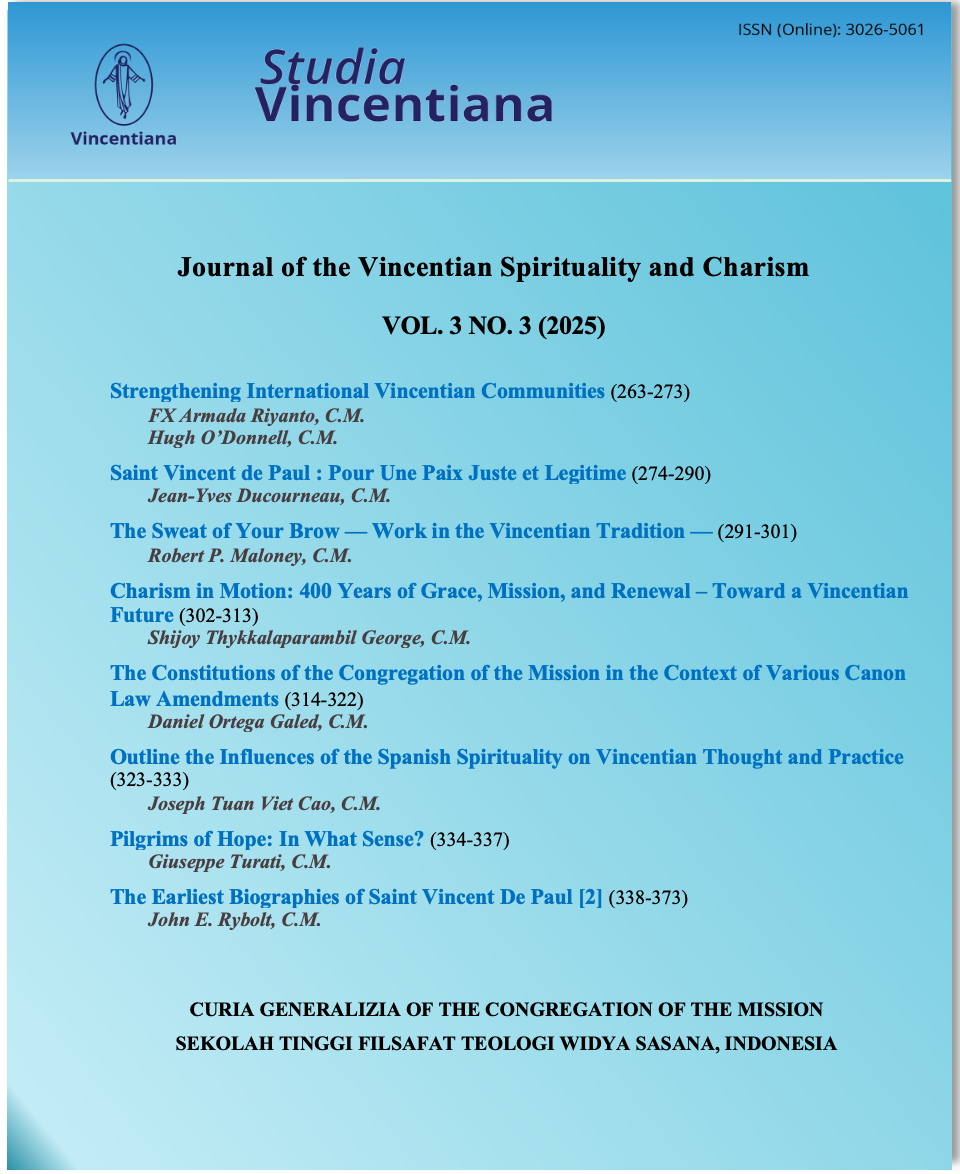
Our Constitutions in the Context of Various Canon Law Amendments
DOI:
https://doi.org/10.35312/7fsahe60Keywords:
constitutions , canon law, motu proprio, amendmentsAbstract
During the twelve years of his pontificate, Pope Francis has issued a number of amendments to the 1983 Code of Canon Law (CIC). These amendments were generally promulgated in the form of motu proprio, and only once in the form of an Apostolic Constitution. Such changes to the Universal Law of the Catholic Church naturally carry implications for our particular law, namely the Constitutions, insofar as the Constitutions directly refer to the Code of Canon Law. It is both interesting and important to review some of these modifications, not only to update our knowledge of ecclesiastical norms, but also because our Constitutions have not yet been revised in light of the various amendments to the CIC itself.
Durante los doce años de su pontificado, el Papa Francisco ha emitido una serie de enmiendas al Código de Derecho Canónico de 1983 (CIC). Estas enmiendas fueron generalmente promulgadas en forma de motu proprio, y solo una vez en forma de Constitución Apostólica. Tales cambios en el Derecho Universal de la Iglesia Católica llevan naturalmente consigo implicaciones para nuestro derecho particular, es decir, las Constituciones, en la medida en que éstas se refieren directamente al Código de Derecho Canónico. Resulta tanto interesante como importante revisar algunas de estas modificaciones, no solo para actualizar nuestro conocimiento de las normas eclesiásticas, sino también porque nuestras Constituciones aún no han sido revisadas a la luz de las diversas enmiendas introducidas en el mismo CIC.
Au cours des douze années de son pontificat, le pape François a promulgué plusieurs amendements au Code de Droit Canonique de 1983 (CIC). Ces amendements ont généralement été publiés sous la forme de motu proprio, et une seule fois sous la forme d’une Constitution Apostolique. De tels changements dans le Droit Universel de l’Église catholique entraînent naturellement des implications pour notre droit particulier, à savoir les Constitutions, dans la mesure où celles-ci se réfèrent directement au Code de Droit Canonique. Il est à la fois intéressant et important de revoir certaines de ces modifications, non seulement pour actualiser notre connaissance des normes ecclésiastiques, mais aussi parce que nos Constitutions n’ont pas encore été révisées à la lumière des divers amendements apportés au CIC lui-même.
References
References
Braga, C. “The Constitutions of the Congregation of the Mission: Historical Notes.” Vincentiana, 44th year, no. 4/5, July–October 2000.
Congregation for Institutes of Consecrated Life and Societies of Apostolic Life. Fraternal Life in Community: “Congregavit nos in unum Christi amor”. 2 February 1994.
________. Circular Letter on the Motu Proprio by Francis, Communis Vita. 8 September 2019.
Danjou, Y. “The Government of the Congregation According to the New Constitutions.” Vincentiana, 44th year, no. 4/5, July–October 2000.
Francis. Apostolic Letter Issued “Motu Proprio” Competentias Quasdam Decernere: Introducing Changes to Some Norms of the Code of Canon Law and the Code of Canons of the Eastern Churches. Given on 11 February 2022.
________. Apostolic Letter Issued Motu Proprio: Communis Vita. Given on 19 March 2019.
________. Litterae Apostolicae Motu Proprio Datae: Recognitum Librum VI, Quibus Can. 695 §1, Codicis Iuris Canonici Immutatur. Given on 26 April 2022.
Lloret, M. “Le Nouveau Droit Canon et La Compagnie des Filles de la Charite. Les Sociétés de Vie Apostolique. Vincentiana, 27th year, no. 6, 1983.
McCullen, R. “Sixteen Years Ago: The New Constitutions, 20 Years of Existence.” Vincentiana, 44th year, no. 4/5, July–October 2000.
Sacra Congregatio pro Religiosis et Institutis Saecularibus. Venite Seorsum: Institutio de Vita Contemplativa et de Monialium Clausura. Rome, 15 August 1969.
Downloads
Published
Issue
Section
License
Copyright (c) 2025 Daniel Ortega Galed, C.M. (Author)

This work is licensed under a Creative Commons Attribution-NonCommercial-ShareAlike 4.0 International License.
License and Copyright Agreement
In submitting the manuscript to the journal, the authors certify that:
- They are authorized by their co-authors to enter into these arrangements.
- The work described has not been formally published before, except in the form of an abstract or as part of a published lecture, review, thesis, or overlay journal.
- That it is not under consideration for publication elsewhere,
- That its publication has been approved by all the author(s) and by the responsible authorities "tacitly or explicitly" of the institutes where the work has been carried out.
- They secure the right to reproduce any material that has already been published or copyrighted elsewhere.
- They agree to the following license and copyright agreement.
Copyright
Authors who publish with Studia Vincentiana agree to the following terms:
- Authors retain copyright and grant the journal right of first publication with the work simultaneously licensed under a Creative Commons Attribution License (CC BY-SA 4.0)that allows others to share the work with an acknowledgment of the work's authorship and initial publication in this journal.
- Authors are able to enter into separate, additional contractual arrangements for the non-exclusive distribution of the journal's published version of the work (e.g., post it to an institutional repository or publish it in a book), with an acknowledgment of its initial publication in this journal.
- Authors are permitted and encouraged to post their work online (e.g., in institutional repositories or on their website) prior to and during the submission process, as it can lead to productive exchanges, as well as earlier and greater citation of published work.

