
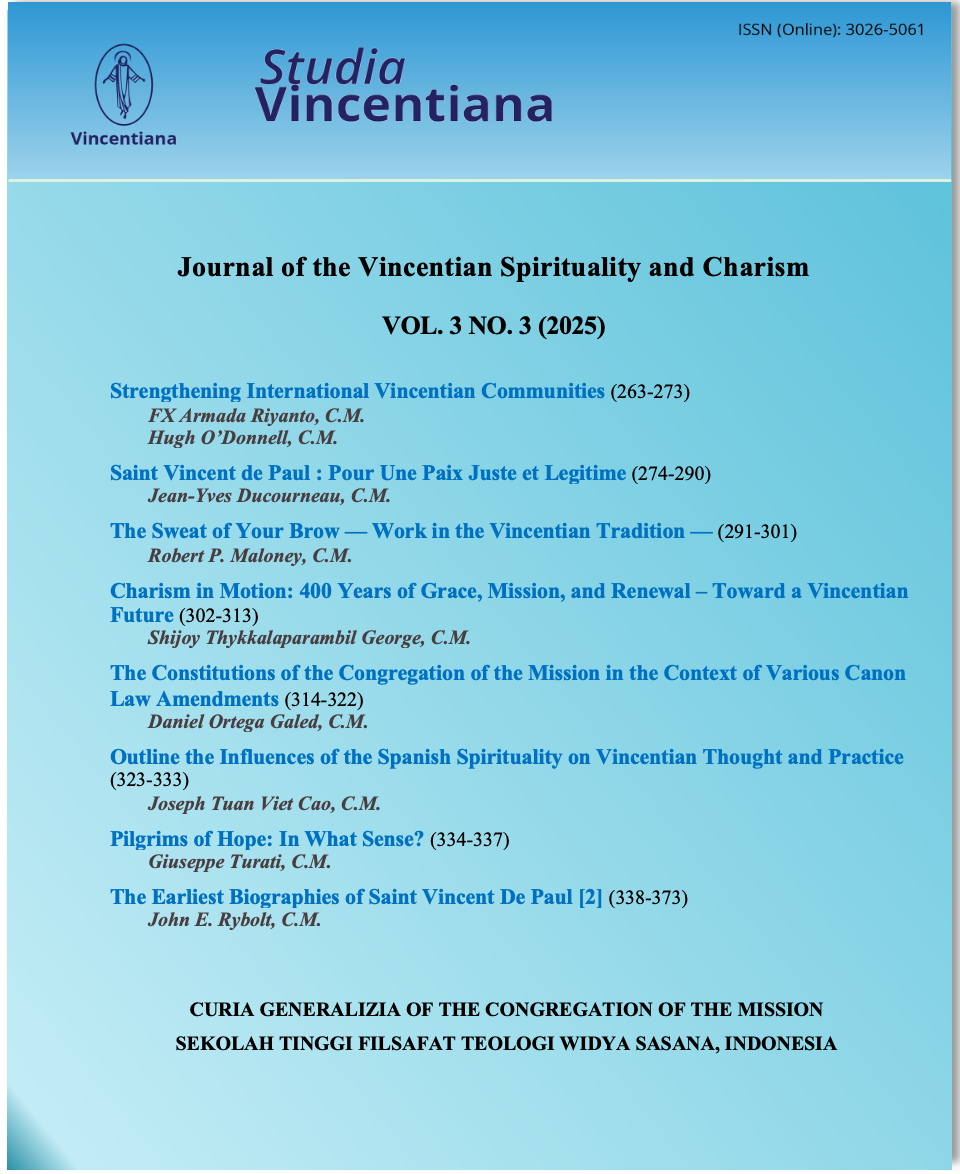
Pilgrims of Hope: In What Sense?
DOI:
https://doi.org/10.35312/egcs8380Keywords:
Pilgrims of hope, Hope, Humanity, JubileeAbstract
This reflection explores the meaning of the Jubilee theme “Pilgrims of Hope” in a historical moment marked by mistrust, despair, and uncertainty about the future. Hope is presented not as a vague wish or individual feeling, but as a fundamental human and theological virtue that enables individuals and communities to face evil, suffering, and apparent failure without surrendering to resignation. Rooted in an anthropological and Christian vision, hope affirms that good has a deeper resonance than evil and that life remains open to transformation beyond what is immediately visible. In contrast to a culture dominated by fear, security obsession, technological control, and disillusionment, hope becomes a communal and generative force capable of inspiring social, ecclesial, and humanitarian action. Christian hope, distinct from mere expectation or optimism, carries the promise that evil does not have the last word. As “pilgrims of hope,” believers are called to resist despair, foster creative transformation, and contribute courageously to building a more humane future.
References
Campisi Tiziana. 2022. “Pellegrini di speranza. Il Giubileo 2025 per costruire un mondo migliore”, https://www.vaticannews.va/it/vaticano/news/2022-06/giubileo-2025-logo-parolinficichella-pellegrini-speranza.html
Diffidenti, Ernesto. 2025. Suicidio: 11 casi al giorno in Italia, giovani più vulnerabili. Ecco i campanelli d’allarme, https://www.ilsole24ore.com/art/suicidio-11-casi-giorno-italia-giovani-piu-vulnerabili-ecco-campanelli-d-allarme-AHLMlFYC?refresh_ce=1
Illich, Ivan. 1972. Descolarizzare la società, Milano, Mondadori.
Moltmann, Jürgen. 1970. Teologia della speranza, Brescia, Queriniana.
Papa Benedetto XVI. 2007. Spe Salvi (30 novembre).
Papa Francesco. 2020. Enciclica Fratelli tutti (3 ottobre).
Zanchetta, Aldo. 2024. Speranza forza sociale, a cura di. Testi di Gustavo Esteva, Elias Gonzáles Gómez, Ana Cecilia Dinerstein, Mauro Armanino, Hermatena Edizioni, 2024
Downloads
Published
Issue
Section
License
Copyright (c) 2025 Giuseppe Turati, C.M. (Author)

This work is licensed under a Creative Commons Attribution-NonCommercial-ShareAlike 4.0 International License.
License and Copyright Agreement
In submitting the manuscript to the journal, the authors certify that:
- They are authorized by their co-authors to enter into these arrangements.
- The work described has not been formally published before, except in the form of an abstract or as part of a published lecture, review, thesis, or overlay journal.
- That it is not under consideration for publication elsewhere,
- That its publication has been approved by all the author(s) and by the responsible authorities "tacitly or explicitly" of the institutes where the work has been carried out.
- They secure the right to reproduce any material that has already been published or copyrighted elsewhere.
- They agree to the following license and copyright agreement.
Copyright
Authors who publish with Studia Vincentiana agree to the following terms:
- Authors retain copyright and grant the journal right of first publication with the work simultaneously licensed under a Creative Commons Attribution License (CC BY-SA 4.0)that allows others to share the work with an acknowledgment of the work's authorship and initial publication in this journal.
- Authors are able to enter into separate, additional contractual arrangements for the non-exclusive distribution of the journal's published version of the work (e.g., post it to an institutional repository or publish it in a book), with an acknowledgment of its initial publication in this journal.
- Authors are permitted and encouraged to post their work online (e.g., in institutional repositories or on their website) prior to and during the submission process, as it can lead to productive exchanges, as well as earlier and greater citation of published work.

