
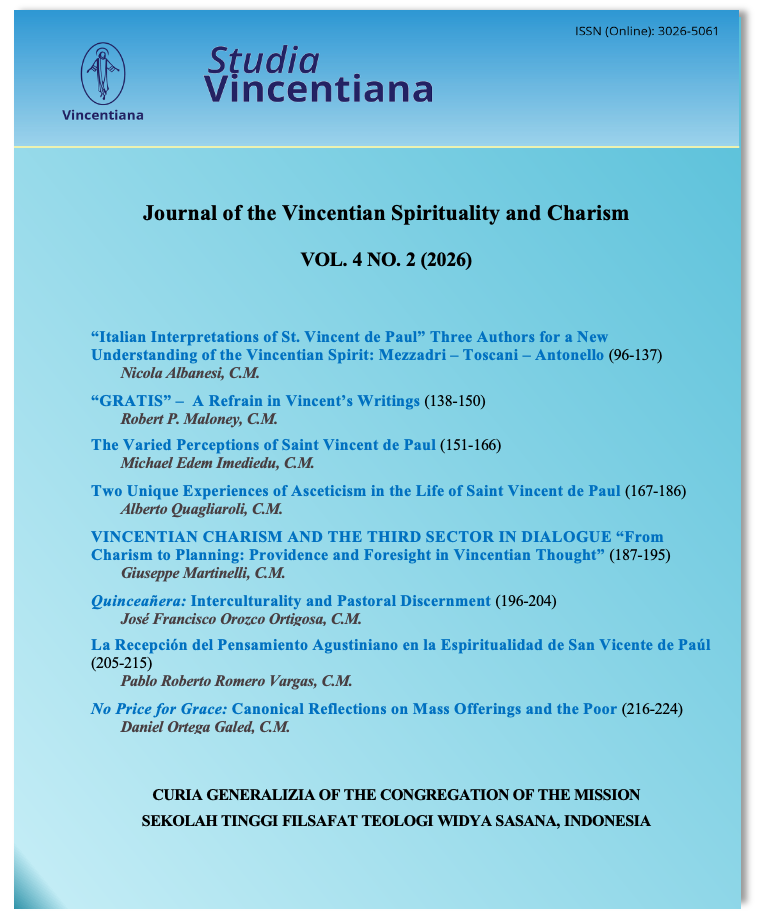
La quinceañera : interculturalité et discernement pastoral
DOI :
https://doi.org/10.35312/tdmxgj50Mots-clés :
Migration, Discernment, Interculturality, QuinceañeraRésumé
La présence croissante de familles migrantes dans les paroisses soulève d'importantes questions pastorales, notamment en ce qui concerne les pratiques culturelles et religieuses propres à leurs pays d'origine. Ces traditions, qu'elles soient religieuses ou culturelles, constituent-elles un obstacle à l'intégration ecclésiale ou peuvent-elles, au contraire, en devenir un facteur de promotion ? Des pratiques telles que la quinceañera sont souvent perçues par de nombreux agents pastoraux comme de simples célébrations sociales, davantage centrées sur la fête que sur la foi, ce qui représente parfois un défi pastoral. Cet article propose une interprétation théologico-pastorale qui considère la quinceañera, ainsi que d'autres expressions paraliturgiques caractéristiques de la religiosité hispanique, comme une occasion privilégiée d'inculturation de l'Évangile. Dans cette perspective, ces célébrations peuvent devenir des catalyseurs de nouvelles formes de vie ecclésiale, capables de renforcer la communion interculturelle et de manifester le caractère pluriel et universel du Royaume de Dieu.
Références
Benedict XVI. Deus Caritas Est (God Is Love): Encyclical Letter. Vatican City: Libreria Editrice Vaticana, 2005.. Available at: https://www.vatican.va/content/benedict-xvi/es/encyclicals/documents/hf_ben-xvi_enc_20051225_deus-caritas-est.html
Blume, Michael A. 2002. Migration and the Social Doctrine of the Church. In People on the Move. N. 88-89. April-December 2002. Ed. Pontifical Council for the Pastoral Care of Migrants and Itinerant People.
Carvalhaes, Cláudio. 2011. “Communitas: Liturgy and Identity.” International Review of Mission 100 (1).
Francisco. Evangelii Gaudium. Exhortación apostólica, 24 de noviembre de 2013. Roma: Libreria Editrice Vaticana, 2013.
Osmer, Richard Robert. 2008. Practical Theology : An Introduction. William B. Eerdmans Pub. Co.
Pontifical Council for the Pastoral Care of Migrants and Itinerant People. Erga migrantes caritas Christi (The love of Christ towards migrants). Instruction. May 14, 2004. https://www.vatican.va/roman_curia/pontifical_councils/migrants/documents/rc_pc_migrants_doc_20040514_erga-migrantes-caritas-christi_en.html.
Téléchargements
Publiée
Numéro
Rubrique
Licence
(c) Copyright José Francisco Orozco Ortigosa, C.M. (Author) 2026

Ce travail est disponible sous licence Creative Commons Attribution - Pas d’Utilisation Commerciale - Partage dans les Mêmes Conditions 4.0 International.
License and Copyright Agreement
In submitting the manuscript to the journal, the authors certify that:
- They are authorized by their co-authors to enter into these arrangements.
- The work described has not been formally published before, except in the form of an abstract or as part of a published lecture, review, thesis, or overlay journal.
- That it is not under consideration for publication elsewhere,
- That its publication has been approved by all the author(s) and by the responsible authorities "tacitly or explicitly" of the institutes where the work has been carried out.
- They secure the right to reproduce any material that has already been published or copyrighted elsewhere.
- They agree to the following license and copyright agreement.
Copyright
Authors who publish with Studia Vincentiana agree to the following terms:
- Authors retain copyright and grant the journal right of first publication with the work simultaneously licensed under a Creative Commons Attribution License (CC BY-SA 4.0)that allows others to share the work with an acknowledgment of the work's authorship and initial publication in this journal.
- Authors are able to enter into separate, additional contractual arrangements for the non-exclusive distribution of the journal's published version of the work (e.g., post it to an institutional repository or publish it in a book), with an acknowledgment of its initial publication in this journal.
- Authors are permitted and encouraged to post their work online (e.g., in institutional repositories or on their website) prior to and during the submission process, as it can lead to productive exchanges, as well as earlier and greater citation of published work.

